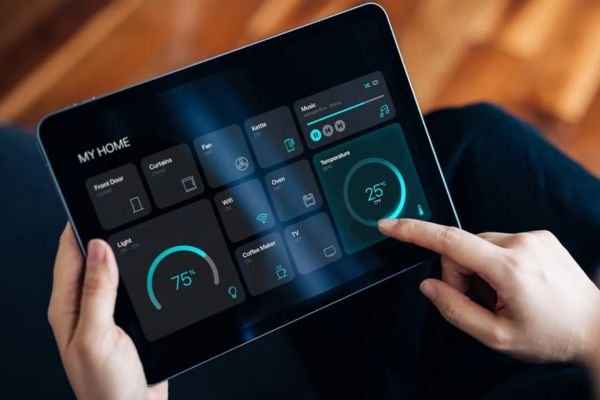

The concept of smart homes is shifting from purely connecting to devices towards a new age of intelligent living that turns the concept of reactive automation into proactive automation. The traditional approach to automation is based on rule-based systems that only respond when told to do so by the user. The automation systems would perform a defined routine without the ability to be compatible with other devices. These systems cannot adapt, anticipate, or personalize the experience.
Generative AI is a type of reactive AI that really changes the story. Instead of following stiff “if-then” logic, it uses predictive adaptation. It learns from your daily behaviours, the weather, and occupancy to create optimal schedules without any manual input.
Voice assistants evolve into conversational companions that can understand natural language and nuanced requests. Those manual rule updates disappear with self-learning systems that autonomously adjust as life changes. Compatibility issues fade thanks to adaptive integration, which lets devices from different brands work together seamlessly. Even security improves with behavioural threat detection; this reduces false alarms by distinguishing routine activity from real risks.
As homes evolve from reactive systems to truly intelligent environments, it is important to understand this transformation. Let’s look at how we moved from traditional automation to the era of generative AI, and why this shift is truly redefining the meaning of ‘smart’.
Evolution: From Traditional Automation to Generative AI
Smart homes are evolving from simple, rule-based automation (like IF-THEN logic) to more advanced, context-aware systems powered by Generative AI. While traditional setups depended on fixed conditions and basic sensors for convenience, they often fell short in flexibility and context, leading to what many refer to as “automation fatigue.”
Traditional Automation: The Foundation
In the early days of smart homes, we saw devices like programmable thermostats and voice assistants such as Alexa. These technologies operated based on set rules, needed several different apps, and could not grasp user intent. They were more reactive than proactive, rigid, and didn’t quite live up to the “smart” label.
Generative AI: The Revolution
Generative AI identifies patterns, anticipates user intent, and produces tailored responses through sophisticated models like LLMs, Transformers, and GANs. It can interpret vague requests like “make the living room cozy for movie night” and automatically adjusts the lighting, temperature, and sound to create the perfect atmosphere.
Key Shifts in Smart Homes
- Contextual Understanding: It involves understanding context to manage complex, natural commands effectively.
- Personalization: Personalization is key, as it allows for the creation of unique routines tailored to each user.
- Novel Solutions: Additionally, it offers novel solutions like predictive security and energy optimization.
Inside the Smart Home Brain: Technical Layers and Real-World Use Cases
In 2026, the architecture of smart homes will harness the power of Generative AI, forming a robust, multi-layered system that is adept at both proactive planning and responsive execution. This innovative approach goes beyond mere automation, allowing for autonomous reasoning and responses that are aware of their context.
- Perception Layer: Multimodal Awareness
The perception layer of the home functions as the sensory system. It integrates the traditional sensors with an advanced method for incorporating multiple different input modes. This integration is important because it allows the AI to analyse complex situations in which an immediate action is required and make the correct decision.
As an example, a user provides a verbal command to “Pause the recipe,” but, at the same time, the kitchen’s heat and smoke detectors register rapidly escalating smoke levels near the stovetop. Through these input sources, the AI rapidly recognizes and prioritizes user safety through an automated response by shutting off the stove and ventilating the kitchen first, before processing the user’s initial request. In this situation, the AI not only functions as a user support system, but more importantly, it serves as a primary component of household safety.
- Reasoning & Orchestration: The GenAI Core
A Large Language Model (LLM) orchestrates the process of converting abstract objectives into concrete device command actions. Whereas traditional “if-then” rule sets provide prescriptive rules, GenAI employs the use of high-level natural language (rather than strict rules) to make decisions based upon Retrieval-Augmented Generation (RAG), which draws upon the preferences expressed by the home-user, along with the operational capabilities of the device.
As an example, when users say “I’m beginning my work-from-home shift,” a complex chain of reactions occurs. The AI will automatically configure the user’s work environment by gradually dimming any overhead lights while increasing the brightness on the desk lamp; adjusting the temperature on the thermostat to make the user stationary and comfortable, and muting all but the important notifications coming through their smart speakers. This is not a scene that has been predetermined but rather one that has been created in real-time because of interpreting how users want to work at home and using any personal preferences they may have shared with the AI.
- Personalization & Learning
Smart homes provide a convenient, efficient, and safe environment to live in. They allow homeowners to take advantage of automated services while still providing flexibility and control of devices.
As an example, after noticing the living room was vacant most nights after 10 PM, AI created dynamic energy-saving guidelines based on family habits. It lowered the heat to an efficient temperature when no motion was detected, and the thermostat was at 68°F. This approach balances energy efficiency and comfort, optimizing both goals intelligently.
- Execution Layer: Universal Interoperability
By 2026, the Execution Layer will have transitioned away from merely relaying commands for execution to being a very advanced “action planner.” With generative AI, the home environment is no longer limited by rigid, predefined scenes. Rather, the GenAI core serves as an intelligent, real-time orchestration engine translating users’ natural language intentions into an integrated sequence of actions executed using Matter, Zigbee, and Thread protocols.
Let us take an example, when a user says, “I’m coming home from the grocery store in the rain,” GenAI infers they have a full hand and dynamically orchestrates actions: unlocks the door, lights the kitchen path, and activates dehumidification to combat dampness. This agile, real-time response contrasts with rigid IF-THEN rules, delivering human-centric adaptability.
- Security & Privacy Engineering
Privacy will be built into systems in 2025 with the help of edge inference, where sensitive information will be processed on user systems and/or devices. The appropriate safety controls must be implemented in conjunction with anomaly detection processes.
To understand this, let’s investigate an example a unique digital “fingerprint” is created by the generative model from the user’s facial data on their device when the user uses facial recognition to unlock a smart lock. The generative model generates a user profile based only on this digital fingerprint, which is then used to verify the user’s identity. This digital fingerprint does not use or disclose any raw images or other sensitive biometric data to the cloud, thereby greatly enhancing security and privacy.
Engineering & Ethics: Building Trustworthy Smart Homes
In the Engineering Level:
- Advanced Engineering & Privacy
- High-performance systems combined with robust privacy controls.
- Hybrid Architecture: Edge + Cloud
- Edge: Handles low-latency tasks (e.g., turning off stove) via Small Language Models (SLMs).
- Cloud: Processes complex queries using Large Language Models (LLMs).
- Policy Layer for Safety
- Single device graph + integrated user profile database.
- Ensures AI decisions follow safety rules and household habits.
- Interoperability with Matter Protocol
- Standardized communication between brands.
- GenAI adapts legacy tech by converting old signals into modern data structures.
- System Observability
- Dashboards show latency, automation success rates, and energy savings.
- Turns “black box” AI into a transparent, trustworthy utility.
Ethics & Compliance: The Privacy-First Mandate
Trust is upheld through a “Privacy-by-Design” approach. Sensitive information, like biometric fingerprints or raw audio, is processed using Edge Inference and stored locally, ensuring that personal life remains within the confines of the home.
- Consent and Transparency: Users can maintain control through clear opt-in processes and features like “Physical Privacy Modes,” which include hardware mic-cuts.
- Safety Measures: For critical actions, such as changing smart lock permissions, multi-factor authentication is required, and immutable audit trails are created.
- Bias Mitigation: Our engineering teams conduct thorough testing of models to ensure fairness, making sure that the AI does not prioritize the preferences of one household member over another.
- Regulatory Compliance: These systems are designed to surpass global standards such as GDPR and the latest AI governance frameworks, ensuring that the intelligent companion of 2025 is both ethical and effective.
Future of Smart Home Automation
The next phase of smart home development will be characterized by ambient intelligence, where spaces can detect our desires without us having to give explicit instructions. Think about stepping into a room where the lighting, temperature, and music are perfectly set to suit your mood and daily activities.
Generative AI is set to create multi-agent systems, where specialized agents focused on energy, comfort, and security collaborate in real-time for the best results. Moreover, homes will implement predictive maintenance, using smart diagnostics to foresee appliance breakdowns and arrange for service before issues arise.
The idea of energy efficiency is evolving beyond just automation. It will now include interactions with the grid, allowing homes to participate in demand-response programs and share energy with their neighbours.
The future of smart homes isn’t about more devices but systems that think, adapt, and act independently. Generative AI shifts automation to context-aware experiences, anticipating needs naturally. With Multi-Modal Intelligence, smart environments evolve into dynamic ecosystems, learning in real time, optimizing energy, and delivering comfort that mirrors human understanding of space.The development of smart environments aligns with MosChip’s vision of Intelligence on the Edge. Powered by DigitalSky GenAIoT, MosChip delivers advanced cognitive capabilities through 75+ Core AI Models, 30 Edge AI Models, and 20 Generative AI use cases spanning Text, Vision, Audio, NLP, and Agentic Intelligence. Integrated Engineering for an AI-Lead Product Era, MosChip brings together silicon, systems, and software to accelerate innovation end to end. With expertise in model development, fine-tuning, and porting, MosChip enables OEMs to build autonomous, context-aware, scalable, and secure smart home solutions, engineering the next era of intelligent living.
Author Bio:

Rohan is a Lead Engineer – Embedded & System Software with 8+ years of experience in embedded systems, Android, Linux BSPs, and IoT platforms at MosChip Technologies Ltd. He specializes in Wi-Fi access point development, firmware engineering, networking protocols, and system-level integration across RTOS and Linux environments. He is interested in edge AI exploration, network protocol optimization, creating end-to-end custom solutions, and identifying gaps to suggest innovative approaches.