“Unauthorized Bread,” one of the four novellas in Cory Doctorow’s 2019 collection, “Radicalized,” begins with a refugee named Selima confronting a toaster that refuses to accept her bread. Checking the day’s headlines on her refrigerator reveals that the company that makes the toaster has gone bankrupt: “The toaster wasn’t the first appliance to go (that honor went to the dishwasher, which stopped being able to validate third-party dishes the week before when Disher went under), but it was the last straw. She could wash dishes in the sink, but how the hell was she supposed to make toast — over a candle?”
More than two decades into The Future, we’ve got a lot of the tech we were broadly promised. But there’s been serious mission creep in why Americans, at least, keep advancing consumer technologies.
This is fiction, but just barely. In 2022, BMW had to backtrack after users balked at the automaker’s decision to charge drivers a subscription fee to use the heated seats whose hardware was already built into their cars. Hewlett-Packard printers regularly refuse third-party ink cartridges on the grounds that non-HP cartridges risk injecting malware into their networks. LG and Samsung smart appliances collect data that has no bearing on product functionality. People who fork out thousands of dollars for top-of-the-line ovens can’t use certain features unless they connect to WiFi and unlock them.
The Internet of Things — objects, appliances and devices whose built-in technologies connect with via WiFi or Bluetooth to collect data and learn the use patterns of those who operate them — has been upon us for several decades. But much of its whizziness has worn off, and even once-enthusiastic adopters are realizing that tools of the everyday are often needlessly complicated, more frustrating to use and troubleshoot, and less reliable than the less intelligent products they’re meant to replace. And because buying a device or appliance is no longer synonymous with owning it, users are increasingly at the mercy of unscrupulous corporate tactics, including planned or forced obsolescence, revocable terms of use, and mandatory subscriptions and upgrades — all of them evidence of what Doctorow terms ensh*ttification.
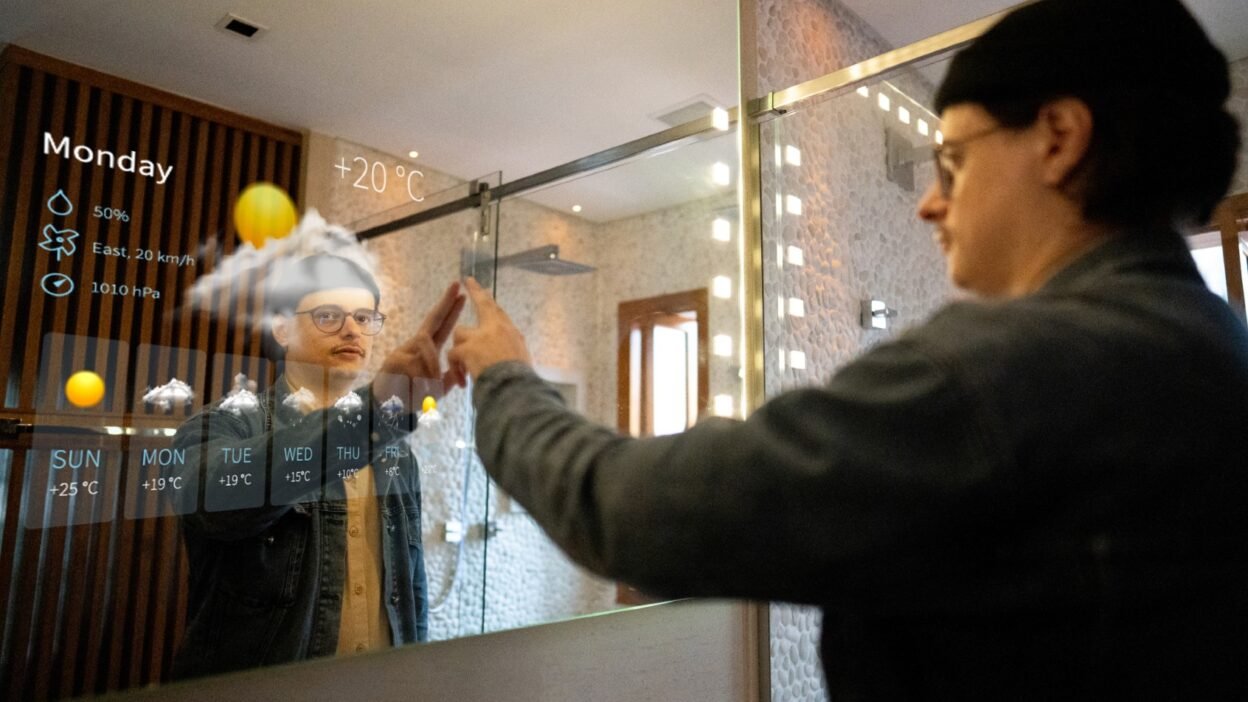
I had to buy a new toothbrush recently, and let’s just say that I was unaware that there had been so much innovation in the teeth-cleaning space. I had every intention of repurchasing a reliable Sonicare, but first I had to muscle past a wall of state-of-the-art, WiFi-enabled toothbrushes with A.I. capabilities that had other ideas: Another Sonicare, huh? Some of us actually care about your teeth, but whatever. Along with smart homes themselves, the Internet of Things that lives inside them — toothbrushes and toilets, biometric beds and hydration-tracking water bottles — are tools whose increasing intelligence uses excess utility in the service of selling self-optimization: Sure, you could use a regular old toothbrush, but you could also stop being a stick-in-the-mud Luddite and invest in you.
A 2024 Ars Technica explainer broke down the ostensible benefits of the smart toothbrush: “There’s a vague algorithm working with an unnamed (likely cheap) processor and sensors to gather information, including how hard, fast, or frequently you brush your teeth. Typically, Bluetooth connectivity enables syncing this data with an app, purportedly letting users see interpretations of their brushing habits and how they could improve.” And yet many products like these have a limited definition of intelligence: None of the 9 brushes in the brand’s iO series, for instance, appears to be voice-activated or have adaptive handles, things that would make them useful to people with arthritis or other grip-limiting conditions. The value they do provide, via “AI brushing recognition” and “3D teeth tracking,” is primarily for the brand, which is not mandated to disclose what it does with the data of its users. (Don’t be surprised if your toothbrush gets in touch to suggest stepping up the time you spend brushing: It would be a real shame if your dental-insurance premium doubled.)
Want more from culture than just the latest trend? The Swell highlights art made to last.
Sign up here
Improving and reinventing how people live and what we spend our time doing was the great sales pitch of the 20th century. Future-focused exhibitions, like the Homes of Tomorrow at Chicago’s 1933 World’s Fair (theme: “A Century of Progress”), let starry-eyed visitors take in the innovations in residential home styles, building materials, and appliances that would become standard in coming decades.
The manufacturing boom that pulled the United States out of the Depression and helped win World War II shifted in peacetime to producing consumer goods and the materials that made them, and innovations from General Electric, Westinghouse and others promised a future of affordable goods, more leisure time and less domestic labor. For men, at least: Ostensibly time-saving appliances marketed to housewives (dishwashers, laundry machines, vacuum cleaners) instead brought forth stricter standards for household hygiene and fewer chores performed communally. The result is what historian Ruth Schwartz Cowan later deemed “the ironies of household technology” in her 1985 study “More Work for Mother.”
By the 1980s, the long-imagined future was a mere 20 decades away and the merging of privatization and surveillance with social conservatism suggested that morning in America was going to include a lot of longing for the past. The futures imagined in pop culture were huge pendulum swings from anticipatory nostalgia (“The Jetsons,” “The Explorers”) to dystopian cynicism (“Brazil” and “Max Headroom”), but were going all in on dystopia by the end of the decade.
How much time and energy will your smartened-up home actually save if you’re spending your one wild and precious life researching each component of it?
But the 1990s came to its end with futurists and other Digital Age stakeholders scrambling to articulate their visions of a bolder, more connected world with cheery, whiz-kid optimism: Bill Gates, in a now-famous 1995 interview with Terry Pratchett, allowed that the internet would probably lead to fake news, but reasoned that the social contract would ensure that it was nipped in the bud: “The whole way that you can check somebody’s reputation will be so much more sophisticated on the Net than it is in print today,” Gates said, apparently ignoring the giant monkey’s paw curling above him. (The predictions sourced from middle schoolers in Billings, Montana in 1984 struck a more prescient tone.)
More than two decades into The Future, we’ve got a lot of the tech we were broadly promised. But there’s been serious mission creep in why Americans, at least, keep advancing consumer technologies. Their potential for paring back labor and maximizing leisure time exists, but isn’t centered: Instead, their value propositions are about increased productivity, efficient data harvesting, and — most important — ROI for shareholders. “Smart Homes and the New White Futurism,” a 2021 article in The Journal of Future Studies, identifies the bait-and-switch of the Internet of Things: “Smart home devices have precipitated a shift away from promoting imaginative technological futures that bring about changes in labor or culture in everyday life toward one of logistics and management that reproduce the status quo.”
That, and a lot of them are trash. The corporate imperative of constant growth and the reality of planned obsolescence, combined with the American consumer’s expectation of each new thing being better and whizzier than the last, make for an ever-yawning gulf between what smart appliances could be and what they are. (Type “Samsung smart refrigerator” into Reddit’s search bar if you doubt me.) There are plenty of people treating smart homes as ongoing labors of love — 3D printing laundry-machine knobs that make that satisfying zzzzzip sound, modifying their kitchen cabinets with hands-free sensors, and inventing garage-door openers that don’t require proprietary apps. But those aren’t the target consumers of manufacturers of smart appliances and gadgets.
Those manufacturers are instead competing for the business of consumers who aren’t home DIY-ers, IT pros and information-security experts — the less-informed potential buyers of products whose ease of use, longevity, interoperability, and reliability depend on dozens of unknown variables. How frequent are the firmware updates on this app-powered smart closet/toilet/thermostat? Exactly what is the smart TV that claims it’s not spying but is definitely spying doing with your data? What if the company that makes it is sold or hexed or declares bankruptcy? And how much time and energy will your smartened-up home actually save if you’re spending your one wild and precious life researching each component of it?
And beyond those questions are even more consequential ones: Why should we buy any product that can stop working at any time, not because there’s anything functionally wrong with them, but because manufacturers and platforms want to extract more money from users? Can we really be expected to put trust in brands whose business models demand constant growth and who can simply hold your cloud-connected, app-enabled showerhead hostage or brick your thermostat for no reason other than greed?
Appliance manufacturers have long been able to count on consumer FOMO and/or fear of being labeled Luddites. But when information-security experts, appliance-repair professionals, tech journalists, and the FBI have a similar set of misgivings, there’s probably good reason to listen. Zillow’s 2026 trend report suggests that real estate listings are more likely to hype reading nooks than WiFi-enabled appliances; Gen Z’s interest in all things analog and reported desire to be less connected has its members pining for the low-tech 1980s and ’90s; horror stories of smart homes whose systems go rogue, get hacked or are weaponized by abusive parties are all too common.
I opted, in the end, not to buy a smart toothbrush. But keeping two crucial questions in mind — How does this particular smart appliance or doodad make my life easier? And who benefits from me using it? — I’m happy to keep my mind open to whatever smart tech comes next. For now, remaining dumb seems like a safe bet.
Read more
about consumer behavior