United States Smart Kitchen Appliances Market Outlook
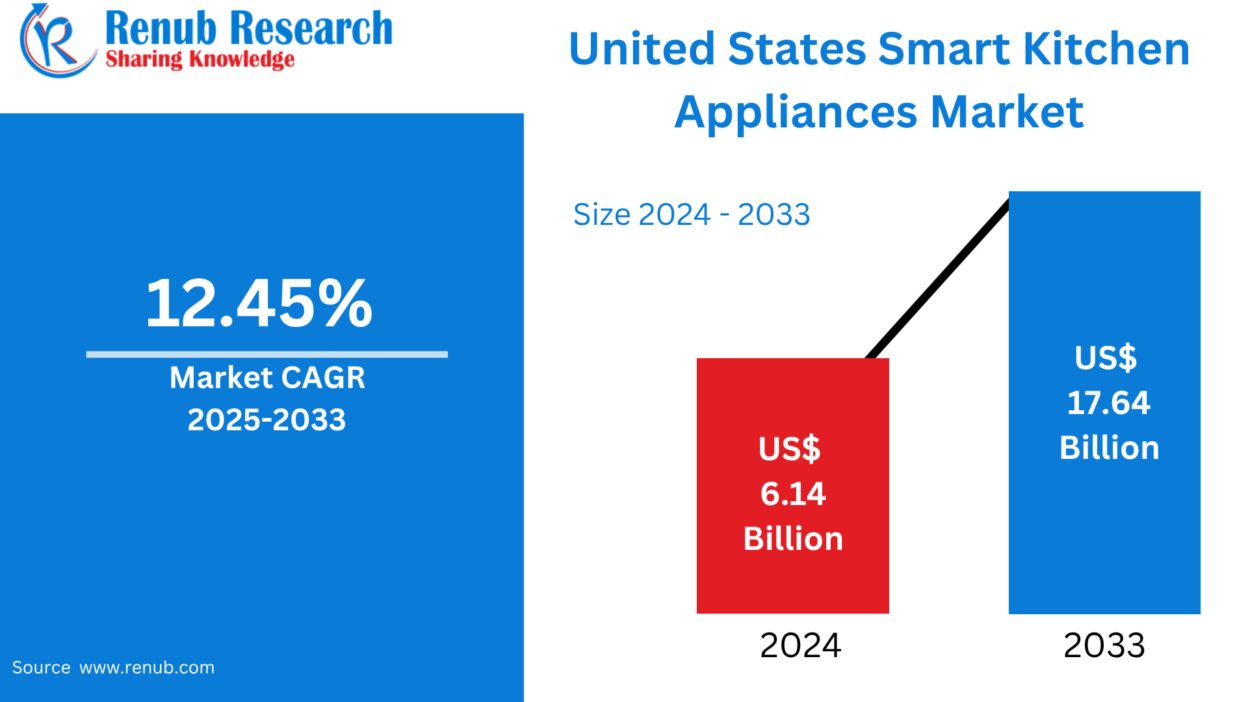
The United States Smart Kitchen Appliances Market is expected to reach US$ 17.64 billion by 2033, rising from US$ 6.14 billion in 2024, expanding at a robust CAGR of 12.45% from 2025 to 2033. This strong growth trajectory reflects the accelerating adoption of connected home technologies, increasing consumer preference for convenience and automation, and rapid innovation in artificial intelligence (AI), sensors, and IoT-enabled devices.
United States Smart Kitchen Appliances Industry Overview
The United States Smart Kitchen Appliances Market is undergoing a dynamic transformation as connected living becomes deeply embedded in household routines. Smart refrigerators that monitor food inventory, ovens that adjust cooking parameters using AI, and dishwashers optimized for water and energy efficiency exemplify how digital intelligence is redefining kitchen functionality.
Several structural factors are fueling this momentum. First, rising internet penetration and widespread availability of high-speed connectivity support seamless integration of appliances into home networks. Second, increasing disposable incomes enable consumers to invest in premium, feature-rich products. Third, the rapid evolution of mobile applications and voice assistants—such as Amazon Alexa, Google Assistant, and Apple HomeKit—has made controlling kitchen appliances intuitive and accessible.
Manufacturers are responding with enhanced interoperability, cloud-based platforms, and data-driven features such as predictive maintenance, personalized cooking recommendations, and real-time energy monitoring. Retailers and e-commerce platforms further strengthen adoption by offering comparison tools, financing options, and product education that demystify smart appliance usage for first-time buyers.
Sustainability is another defining theme. Smart kitchen appliances are increasingly designed to optimize resource usage, minimize waste, and reduce household energy consumption. As environmental consciousness rises, energy-efficient and eco-friendly appliances are becoming preferred choices across American households. Although challenges such as higher upfront costs and data privacy concerns persist, ongoing innovation and growing consumer confidence are expected to sustain market expansion and reshape the modern U.S. kitchen.
Key Factors Driving Market Growth
1. Increasing Adoption of Smart Homes and IoT Integration
The rapid growth of smart home ecosystems is one of the most powerful drivers of the U.S. Smart Kitchen Appliances Market. IoT integration enables appliances to communicate with smartphones, home hubs, and voice assistants, offering users unprecedented control and customization. Consumers can remotely preheat ovens, receive notifications when cooking is complete, or track refrigerator contents while shopping.
The expansion of high-speed Wi-Fi and emerging 5G networks ensures reliable connectivity, supporting advanced features such as AI-powered cooking optimization and automated performance adjustments. As more households adopt smart lighting, security, and climate systems, the kitchen is becoming a natural extension of this connected ecosystem. Interoperability with existing platforms significantly enhances user experience, encouraging broader adoption across demographics.
2. Rising Focus on Energy Efficiency and Sustainability
Energy conservation has become a key purchasing criterion for American consumers. Smart kitchen appliances incorporate sensors and algorithms that optimize electricity and water usage based on real-time needs, helping households reduce utility costs and environmental impact. Features such as adaptive cooling in refrigerators, intelligent wash cycles in dishwashers, and automated standby modes contribute to significant resource savings.
Government incentives, Energy Star certification programs, and stricter efficiency standards further accelerate adoption. Consumers increasingly value appliances that provide detailed insights into consumption patterns, enabling smarter usage decisions. As sustainability moves from a niche preference to a mainstream expectation, energy-efficient smart kitchen appliances are gaining a decisive competitive advantage.
3. Lifestyle Changes and Growing Demand for Convenience
Shifting lifestyles are reshaping the American kitchen. With the rise of dual-income households, remote work, and urban living, consumers seek appliances that save time, simplify meal preparation, and enhance flexibility. Smart ovens, coffee makers, and cooktops that can be scheduled or operated remotely align perfectly with fast-paced routines.
At the same time, the growing interest in home cooking, healthier diets, and personalized meals is driving demand for precision and customization. AI-enabled appliances can adjust cooking parameters based on recipes, food types, and user preferences, delivering consistent results with minimal effort. Compact, multifunctional designs also appeal to apartment dwellers who require space-efficient solutions. Together, these lifestyle trends are accelerating adoption of intelligent kitchen technologies across the country.
Challenges in the United States Smart Kitchen Appliances Market
1. High Initial Costs and Affordability Constraints
Despite strong interest, premium pricing remains a significant barrier to mass adoption. Smart appliances equipped with AI, advanced sensors, and connectivity features are typically more expensive than conventional models. Installation, maintenance, and compatibility with existing home systems can further increase total ownership costs.
Although long-term savings from energy efficiency and improved durability may offset upfront expenses, many price-sensitive consumers remain hesitant. Manufacturers are addressing this challenge by introducing mid-range models, offering financing plans, and promoting bundled solutions. However, affordability will remain a critical factor influencing adoption rates, particularly among middle-income households.
2. Data Privacy and Cybersecurity Concerns
As smart appliances collect and transmit data through cloud platforms, concerns over data privacy and cybersecurity are intensifying. Consumers worry about unauthorized access, misuse of personal information, and vulnerability to hacking. These apprehensions can slow adoption, especially among privacy-conscious users.
To build trust, manufacturers must prioritize secure encryption, regular software updates, and transparent data policies. Compliance with evolving U.S. cybersecurity standards and the integration of customizable privacy settings are becoming essential differentiators. Educating consumers on data protection measures will be critical for sustaining long-term market confidence.
Market Overview by Key States
California
California leads the nation in smart kitchen appliance adoption, driven by its tech-forward population, strong sustainability culture, and widespread smart home integration. Eco-conscious consumers prioritize energy-efficient and water-saving appliances, while the state’s innovation ecosystem supports rapid adoption of AI-enabled cooking and energy management solutions. High purchasing power, urbanization, and environmental regulations position California as a benchmark market for premium smart kitchen technologies.
Texas
Texas is emerging as a high-growth market due to rapid urban development, population expansion, and increasing investments in modern housing. Major metropolitan areas such as Houston, Dallas, and Austin are witnessing rising demand for connected appliances that enhance convenience and optimize energy usage. Localized marketing, financing options, and integration with smart home infrastructure are accelerating adoption, making Texas a key contributor to national market growth.
New York
New York’s market is shaped by dense urban living, fast-paced lifestyles, and strong digital connectivity. Consumers favor compact, multifunctional, and tech-integrated appliances that save space and time. Sustainability trends and the state’s emphasis on energy efficiency further support adoption. With a highly tech-savvy population and extensive retail and e-commerce penetration, New York remains a strategic hub for innovation-driven smart kitchen solutions.
Florida
Florida’s growing residential sector, diverse demographics, and rising smart home installations are driving steady growth. Both young professionals and retirees are adopting user-friendly, voice-controlled appliances that enhance convenience and reduce energy consumption. Retailers are promoting bundled solutions, while manufacturers target the state with aesthetically appealing, intelligent products compatible with major smart home platforms. Florida continues to gain importance as a lifestyle-driven market for smart kitchen appliances.
Recent Developments in the U.S. Smart Kitchen Appliances Market
February 2025: GE Appliances launched a wireless Smart Probe featuring AI-powered recipe recommendations through SmartHQ visual recognition.
February 2025: GE Appliances partnered with ABB to integrate the ReliaHome Smart Panel into its EcoBalance ecosystem, enhancing whole-home energy efficiency.
January 2025: Instacart and Samsung Electronics introduced AI Vision-enabled shoppable refrigerators that recognize stored items and enable one-click refilling.
January 2025: Whirlpool Corporation reported its 2024 full-year and Q4 results, highlighting $300 million in cost reductions and continued efficiency initiatives, with an additional $200 million in savings targeted through 2025.
September 2024: Midea Group showcased advanced smart home appliances at IFA 2024, emphasizing “Friendly Innovations for Homes” and accessible intelligent technologies.
These developments highlight a market increasingly defined by AI integration, energy optimization, and ecosystem partnerships.
Market Segmentation
By Product
Smart Refrigerators
Smart Cookware & Cooktops
Smart Ovens
Smart Dishwashers
Others
By Connectivity Technology
Bluetooth
Wi-Fi
NFC
Others
By Application
Residential
Commercial
By States
California, Texas, New York, Florida, Illinois, Pennsylvania, Ohio, Georgia, New Jersey, Washington, North Carolina, Massachusetts, Virginia, Michigan, Maryland, Colorado, Tennessee, Indiana, Arizona, Minnesota, Wisconsin, Missouri, Connecticut, South Carolina, Oregon, Louisiana, Alabama, Kentucky, Rest of United States.
Competitive Landscape
The U.S. Smart Kitchen Appliances Market is highly competitive, with global and regional players focusing on innovation, brand differentiation, and ecosystem integration. Key strategies include product launches, partnerships, AI integration, and sustainability initiatives.
Leading Companies:
AB Electrolux
Samsung Electronics Co. Ltd
Whirlpool Corporation
LG Electronics Inc.
BSH Home Appliances Corporation
Panasonic Corporation
Haier Group
Breville Group Limited
Miele
Philips
These companies are investing in R&D to enhance connectivity, user experience, and energy efficiency while expanding their portfolios across premium and mid-range segments.
Market Size and Forecast (Renub Research)
According to Renub Research, the United States Smart Kitchen Appliances Market will grow from US$ 6.14 billion in 2024 to US$ 17.64 billion by 2033, registering a CAGR of 12.45% during 2025–2033. This growth is supported by increasing smart home adoption, continuous technological advancements, and rising consumer demand for efficient, automated, and sustainable kitchen solutions.
Final Thoughts
The United States Smart Kitchen Appliances Market is entering a transformative era where connectivity, AI, and sustainability converge to redefine everyday cooking and household management. As consumers increasingly prioritize convenience, personalization, and energy efficiency, smart appliances are evolving from luxury items into essential components of modern homes.
While challenges such as high initial costs and data privacy concerns remain, continuous innovation, competitive pricing strategies, and robust cybersecurity frameworks are expected to overcome these barriers. With strong growth prospects, expanding state-level adoption, and active participation from global industry leaders, the smart kitchen is poised to become the centerpiece of the connected American home.
For businesses, investors, and technology providers, the next decade presents a compelling opportunity to shape how households cook, conserve energy, and interact with their living spaces—one intelligent appliance at a time.