
Chinese tech companies are expanding their flagship offerings to penetrate the Korean market. After successfully easing Korean consumers’ skepticism toward Chinese electronics by leveraging competitive robot vacuum cleaners, these firms are now poised to enter ordinary Korean households through entry-level humanoid robots available to individual consumers and stronger smart home product lineups.
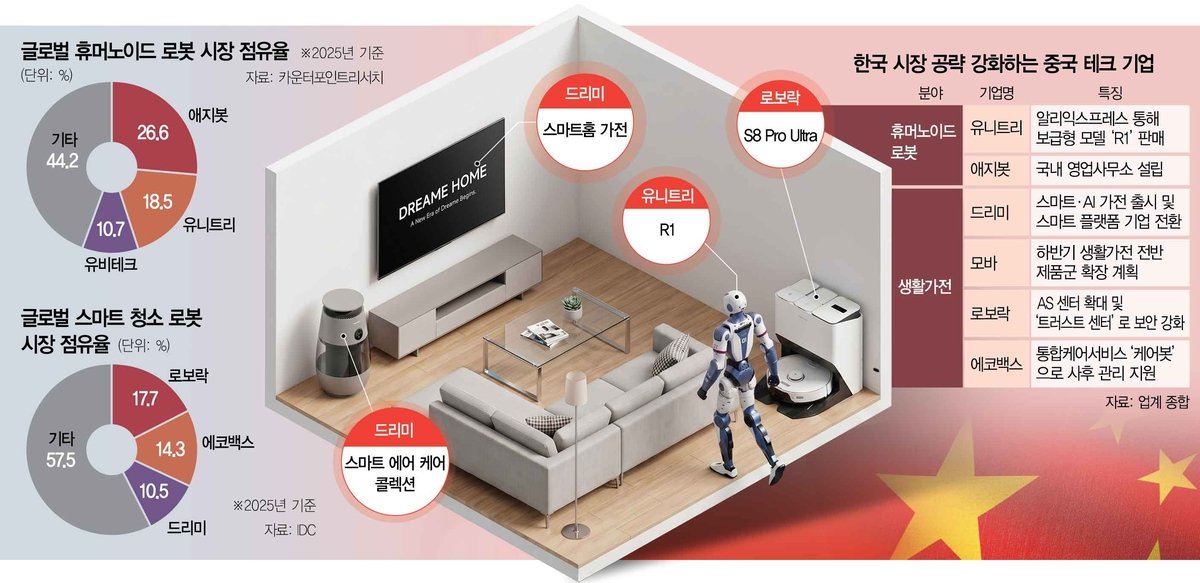
According to the information technology (IT) industry on the 21st, China’s Unitree began selling its entry-level model “R1” on AliExpress this month. The product is priced at 22.72 million won, roughly half the price of its high-performance “G1” model.
The launch of a low-cost humanoid is seen as a move targeting general consumers in the Korean market. Unitree has so far sold its robots in Korea primarily to universities and corporate research institutes through distribution agreements with three local companies. While it has yet to establish a domestic office or branch, the company plans to accelerate its overseas expansion by actively leveraging the AliExpress platform, which has grown into a global e-commerce powerhouse.
Chinese humanoid firm AgiBot is also accelerating its push into the Korean market. The company opened a sales office in Seoul in March this year and is reviewing plans to establish a Korean subsidiary depending on future performance. “Since the humanoid market is still in its early stages, it is uncertain whether the business will succeed in Korea, but the country carries significant symbolic value as a major nation close to China,” a robotics industry official said. “If the market response is favorable, the company will pursue aggressive sales.”
The two firms are vying for the top spot in the global humanoid robot market, suggesting their impact will be substantial. Unitree sold 5,500 humanoid robots last year and aims to supply 20,000 units this year by aggressively targeting overseas markets. AgiBot announced at the end of March that its cumulative shipments had reached 10,000 units.
The offensive from Chinese home appliance makers is also intensifying. Having quickly captured share in the Korean market, these companies have chosen the smart home-centered home appliance market as their next growth driver. They are expanding their product portfolios into air purifiers, televisions, and water purifiers to grow into comprehensive home appliance brands, while simultaneously strengthening security and after-sales service systems to broaden their footing in the Korean market.
A leading example of the smart home shift is Dreame. At its recent tech conference “Dreame Next,” the company unveiled its vision to build an integrated ecosystem connecting smart home appliances such as refrigerators and TVs onto a single platform, going beyond robot vacuum cleaners. Building on this, it has introduced smart air care products such as air purifiers and electric fans in the Korean market. As Korean firms including SK Intelix and Ceragem expand artificial intelligence (AI) and smart home-based services, Chinese home appliance companies are also entering the competition, making the broader market’s shift toward connected smart home platforms increasingly evident.
Mova, which entered the Korean robot vacuum cleaner market last year, is also pushing to expand its product range across home appliances in the second half of this year. “Last year, we focused on entering the robot vacuum cleaner market and building brand awareness, but this year we are reviewing plans to expand our product range across home appliances,” a Mova official said.
Behind Chinese robot vacuum makers’ expansion into home appliances lies their assessment that they have already secured leadership in the global robot vacuum market. According to market research firm IDC, last year’s global smart cleaning robot market share stood at 17.7% for Roborock, 14.3% for Ecovacs, and 10.5% for Dreame, with the top players accounting for nearly half of the market.
In particular, to win over the Korean market, the firms are investing heavily in personal data protection and after-sales service (AS) systems, areas where consumer sensitivity is high. Roborock is strengthening its security system through its “Trust Center” while expanding domestic AS center operations and introducing on-site AS services. Ecovacs is also reinforcing its after-sales support through its integrated care service “CareBot.” “Stronger competitiveness in security and after-sales service will work to their advantage in establishing themselves as comprehensive home appliance brands beyond mere robot vacuum cleaner makers,” an industry official said.