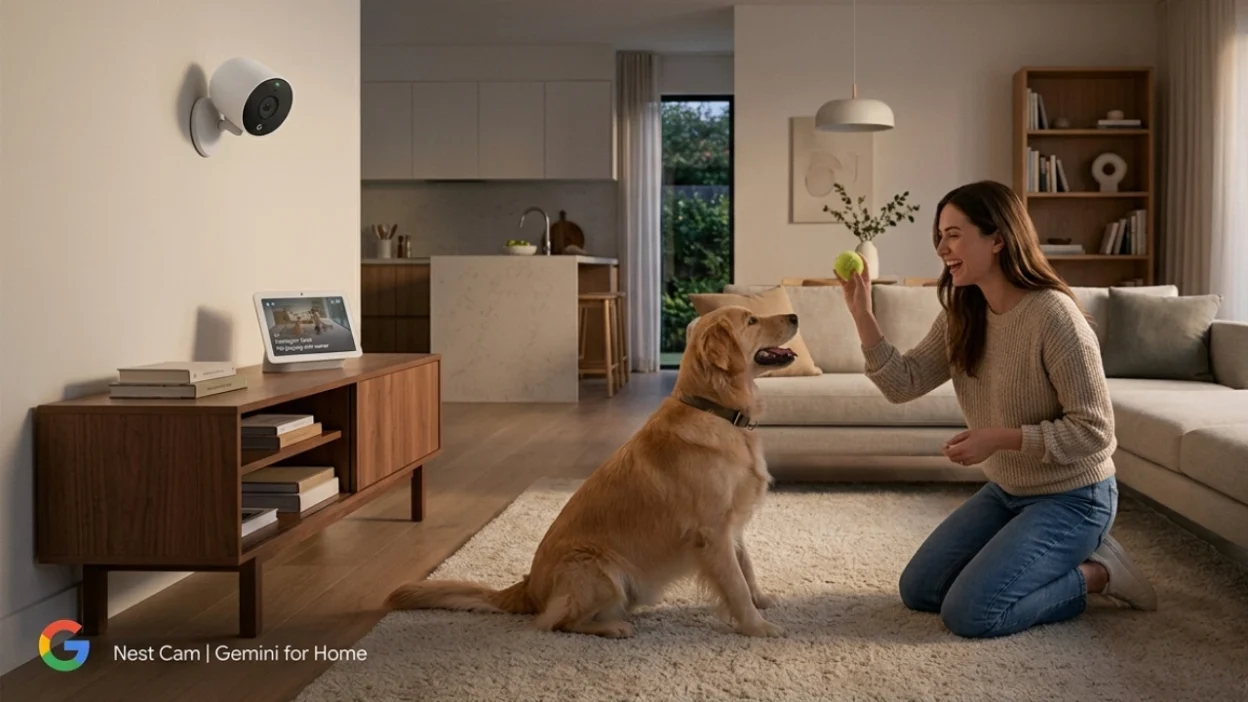
Google is making its smart home system much smarter with a major Gemini For Home upgrade. Earlier, smart home automations worked in a very fixed way, like “if motion happens, turn on the light.” But now, Google’s Nest cameras and some supported third-party cameras can actually understand what they are looking at.
This means your camera is no longer just recording video. It can recognize situations, people, pets, vehicles, and activities and then automatically trigger actions around your home. Google calls this “advanced scene understanding.”
Google Gemini for Home Turns Nest Cameras Into AI-Powered Smart Home Assistants
Google’s new Gemini for Home upgrade lets Nest cameras recognize scenes, people, pets, and activities, triggering smart home automations with simple natural-language commands. Google showed some surprisingly fun examples that instantly caught people’s attention online. One user created a setup where their camera recognizes raccoons in the backyard and automatically sends alerts so they can watch them together with family.
For example, you can now create automations using simple everyday language. You can tell Google Home things like “when my cat waits near the back door, send me a notification” or “when my blue car leaves the driveway, turn off the lights and TV.” The AI will use the camera feed to understand those situations and automatically run the actions.

Another person made an automation that starts meditation music, dims the lights, and warms the room whenever the camera spots them sitting on a yoga mat. Someone else even programmed their house to detect when their husband is doing yard work so outdoor speakers automatically blast EDM music while they bring him lemonade. It sounds funny at first, but it also shows how personal smart homes are becoming.
Salient Features
To access the feature right now, users need the Google Home public preview app, compatible cameras, and the Google Home Premium subscription plan. The rollout is currently limited to early access users in the United States, but Google plans to expand availability later this year.
The numbers make this even crazier. The global smart home market is racing toward more than $600 billion this decade, while millions of homes are already packed with connected devices. Big Tech knows the next battlefield is not your pocket but your living room. Google is basically betting that your future home will not just respond to commands but understand context. And honestly, the genie is already out of the bottle.
Global Market Database
Honestly, this feels like one of those moments where smart homes stop being gimmicky and start becoming genuinely useful. Your camera is no longer just watching your house. It is understanding it. And whether that sounds exciting or slightly creepy probably depends on how much you trust AI quietly running in the background of your daily life.
| Market Segment | Latest Data | Why It Matters |
| Global Smart Home Market | Expected to grow from nearly $150.6 billion in 2024 to around $633.2 billion by 2032 | AI-powered homes are becoming one of the fastest-growing tech industries worldwide |
| Smart Home Security Camera Market | Projected to hit $56.47 billion by 2033 with 22.1% CAGR growth | AI cameras like Google Nest are driving the next big upgrade cycle in home security |
| Smart Home Security Industry | Valued at over $41.3 billion in 2025 and expected to cross $104.5 billion by 2033 | Consumers are prioritizing AI based home monitoring and automation systems |
| India Smart Home Market | India’s smart home user base crossed 15 million users in 2024 | India is becoming one of the fastest-growing smart home markets globally |
| US Smart Device Adoption | Around 63% of US households own at least one smart home device | Smart homes are moving from luxury to mainstream. |
| Major Industry Players | Google, Amazon, Apple and Samsung Electronics are heavily investing in AI homes | Big Tech sees smart homes as the next major AI ecosystem battle |
| Biggest Market Shift | Smart homes are evolving from rule-based systems to predictive AI ecosystems | Homes are starting to learn routines instead of waiting for manual commands |

Final Verdict
Google’s Gemini for Home feels like the moment smart homes finally stopped acting like stubborn machines and started behaving more like an observant roommate who actually gets you. Earlier, cameras could only detect motion, such as a security guard pressing the same button repeatedly.
Now they can understand scenes, recognize activities, and automatically trigger actions. Your house can notice your cat waiting outside, your car leaving the driveway, or even your yoga session starting and react instantly. That is not just automation anymore; that is ambient AI quietly blending into everyday life.