Smart homes are no longer futuristic concepts reserved for luxury villas or science-fiction movies. Across India, homeowners are embracing technology that allows them to control lighting, security systems, appliances, entertainment devices, and climate settings with a simple voice command or smartphone tap. What was once considered a premium lifestyle upgrade is rapidly becoming a mainstream necessity.
India is currently experiencing a significant transformation in the way people interact with their homes. Driven by increasing internet penetration, widespread smartphone adoption, rising disposable incomes, and growing awareness of energy efficiency, the home automation sector is witnessing remarkable growth.
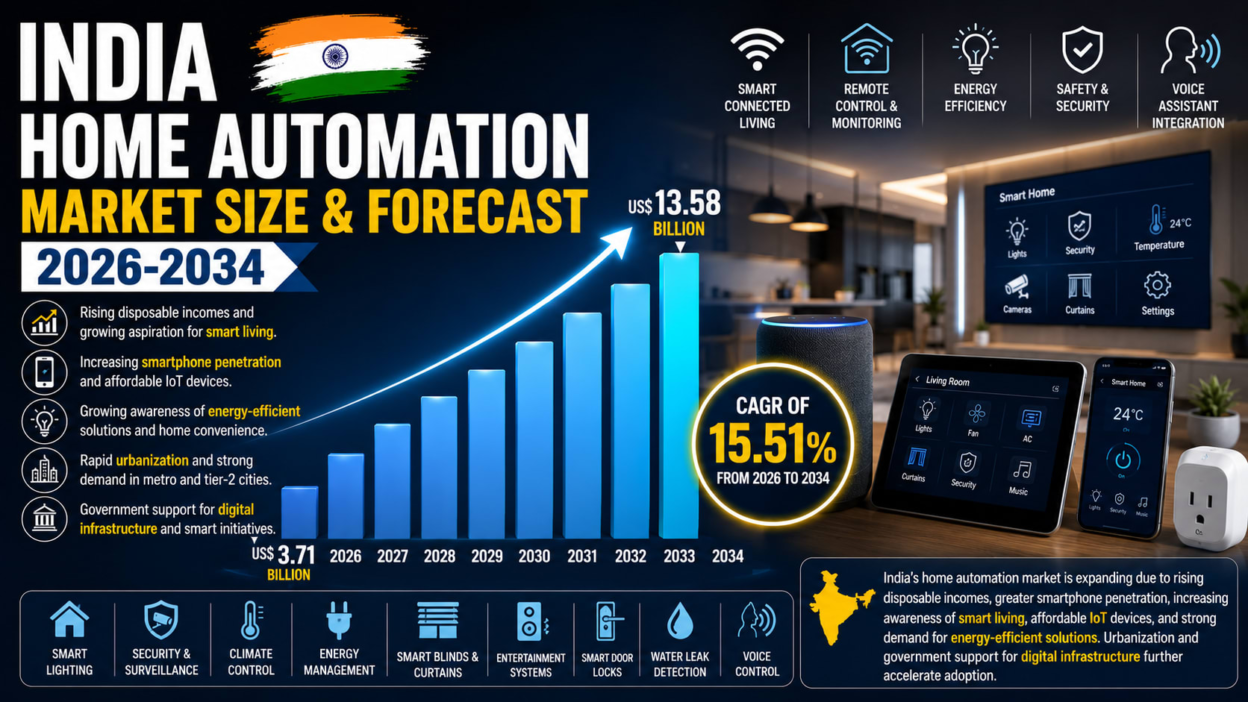
According to Renub Research, the India Home Automation Market is projected to grow from US$ 3.71 billion in 2025 to US$ 13.58 billion by 2034, expanding at a compound annual growth rate (CAGR) of 15.51% between 2026 and 2034. These impressive figures highlight how smart home technology is becoming an essential part of modern living across the country.
Understanding Home Automation
Home automation refers to the integration of smart technologies that allow homeowners to remotely monitor, manage, and automate various household functions. Through connected devices powered by the Internet of Things (IoT), artificial intelligence, cloud computing, and wireless networks, users can enjoy greater convenience, security, and energy efficiency.
Modern home automation systems can manage lighting systems, security cameras, smart locks, entertainment devices, climate control systems, smart sensors, household appliances, and energy management solutions. These systems communicate with one another through centralized platforms, creating a seamless and connected living experience.
As technology becomes more affordable and user-friendly, smart homes are becoming increasingly accessible to middle-class households throughout India.
Why Smart Homes Are Gaining Popularity in India
India’s home automation market is benefiting from several strong growth factors that are reshaping consumer preferences and lifestyle expectations.
One of the most important drivers is the growing desire for convenience. Modern consumers lead busy lives and increasingly seek technologies that simplify daily routines. Whether it’s automatically adjusting room temperatures before arriving home or remotely checking security cameras while traveling, automation offers unmatched ease and flexibility.
At the same time, rising disposable incomes have enabled more households to invest in advanced technologies. As purchasing power improves, consumers are prioritizing products that enhance comfort, security, and quality of life.
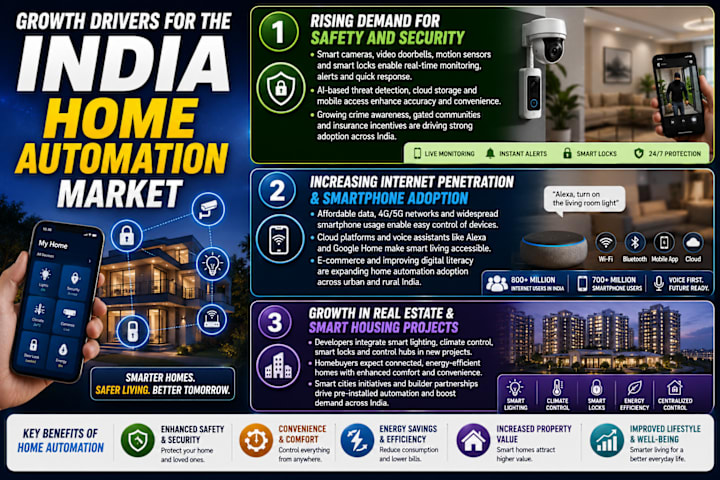
The rapid growth of smartphone usage has also accelerated adoption. India has become one of the world’s largest smartphone markets, giving millions of consumers easy access to home automation applications. With affordable mobile devices and inexpensive internet plans, homeowners can now control their homes from virtually anywhere.
Voice-controlled assistants have further simplified the experience. Smart speakers and virtual assistants have transformed home automation from a complex technology into an intuitive and accessible solution for everyday users.
Security Remains the Biggest Growth Driver
Among all smart home applications, security solutions continue to generate the highest demand.
Urbanization, changing family structures, and increasingly mobile lifestyles have made home security a top priority for many Indian households. Working professionals often spend long hours away from home, while frequent travelers seek reliable ways to monitor their properties remotely.
Smart security technologies such as video doorbells, AI-powered surveillance cameras, motion sensors, smart locks, cloud-connected monitoring systems, and real-time mobile alerts provide homeowners with greater peace of mind.
These solutions allow users to instantly receive notifications about suspicious activities, monitor live video feeds, and even remotely control access to their properties.
The growing popularity of gated communities, premium residential projects, and luxury apartments has further strengthened demand for integrated security automation systems. Many developers now include advanced security features as standard amenities, recognizing the increasing expectations of modern homebuyers.
The Role of Energy Efficiency
Energy efficiency has become another major reason behind the growing adoption of home automation systems.
Consumers are increasingly aware of rising electricity costs and environmental concerns. Smart technologies help address both challenges by optimizing energy consumption throughout the home.
Automated lighting systems can switch off unused lights, while smart thermostats can regulate temperatures based on occupancy and user preferences. Energy monitoring solutions provide real-time insights into consumption patterns, allowing homeowners to identify inefficiencies and reduce waste.
As sustainability becomes a greater priority, smart home technologies are expected to play an increasingly important role in helping households lower energy usage and reduce their carbon footprint.
Real Estate Developers Are Driving Adoption
The real estate industry has emerged as a crucial contributor to India’s home automation growth story.
Developers are increasingly incorporating smart home features into residential projects to attract technology-conscious buyers and differentiate themselves in a competitive market. Homebuyers today expect more than just attractive interiors; they seek homes that offer convenience, connectivity, and future-ready infrastructure.
Many new residential projects now feature automated lighting systems, smart access controls, integrated security networks, voice-enabled controls, centralized automation hubs, and energy management solutions.
Luxury apartments and gated communities are particularly leading this trend. However, automation features are gradually becoming common even in mid-range housing developments as consumer demand continues to increase.
Government initiatives focused on digital transformation and smart city development are also encouraging broader adoption of connected living technologies.
Technologies Powering India’s Smart Home Revolution
Several advanced technologies are working together to fuel the expansion of home automation across the country.
The Internet of Things serves as the foundation of smart homes by enabling connected devices to communicate and share information. Through IoT, appliances, security systems, sensors, and lighting solutions can operate as part of a unified ecosystem.
Artificial intelligence adds intelligence to these systems by learning user preferences and automating routine tasks. AI-powered solutions can recognize behavioral patterns, optimize energy consumption, and improve security through advanced threat detection capabilities.
Cloud computing allows homeowners to access and manage their systems remotely through mobile applications. Whether adjusting lighting settings or checking surveillance footage, users can stay connected to their homes from virtually anywhere in the world.
Meanwhile, advancements in wireless connectivity, including expanding 4G and 5G networks, are making smart home systems faster, more reliable, and easier to install.
Regional Markets Leading Growth
Several Indian cities have emerged as key growth centers for home automation adoption.
Pune is one of the fastest-growing markets due to its thriving IT industry, expanding residential infrastructure, and large population of young professionals. Areas such as Baner, Hinjewadi, Kharadi, and Wakad have witnessed increasing demand for smart living solutions.
Delhi NCR remains one of India’s most mature home automation markets. High-income households, luxury housing developments, and strong consumer awareness have made the region a major hub for smart home adoption. Residents increasingly invest in surveillance systems, video door phones, smart locks, climate control technologies, and integrated automation platforms.
Mumbai’s premium residential sector also plays a significant role in market growth. High-rise apartments, demanding work schedules, and a growing focus on convenience have encouraged homeowners to adopt connected technologies that improve security and optimize daily living.
Hyderabad is rapidly emerging as another promising market. The city’s expanding technology sector, modern residential developments, and digitally savvy population have created favorable conditions for smart home adoption. Areas such as Gachibowli, Hitech City, and Kondapur continue to drive demand for advanced automation solutions.
Challenges Facing the Industry
Despite its impressive growth trajectory, the home automation market still faces several challenges.
One of the most significant barriers is the relatively high upfront cost of smart home systems. Although prices have become more affordable over time, many consumers still perceive automation as a luxury rather than a necessity. Installation costs and maintenance expenses can further discourage adoption, particularly in smaller cities and budget-conscious households.
Another challenge involves compatibility issues between devices from different manufacturers. Consumers often struggle to integrate multiple products into a single ecosystem, leading to frustration and reduced user satisfaction.
Cybersecurity concerns also remain important. As homes become increasingly connected, protecting personal data and ensuring network security have become critical priorities. Manufacturers must continue investing in stronger security measures to build consumer confidence.
In addition, technical support and after-sales service remain limited in some regions, creating obstacles for wider adoption outside major metropolitan areas.
Recent Industry Developments
The home automation industry continues to evolve through strategic investments, technological innovation, and product launches.
In June 2025, Signify and Dixon Technologies announced a joint venture aimed at expanding domestic lighting manufacturing capabilities in India. This development is expected to strengthen local production and support growing demand for connected lighting solutions.
Samsung introduced its 2025 Bespoke AI appliance lineup, highlighting the increasing integration of artificial intelligence into everyday household products.
Schneider Electric India also expanded its smart home portfolio through new product launches designed to promote connected living experiences and improve consumer engagement with automation technologies.
Government programs supporting renewable energy adoption and digital infrastructure development continue to create favorable conditions for long-term market growth.
Looking Ahead
The future of India’s home automation market appears exceptionally bright.
As technology becomes more affordable and awareness continues to grow, smart home solutions are expected to move beyond metropolitan cities into Tier-2 and Tier-3 markets. The combination of artificial intelligence, IoT, cloud computing, and advanced connectivity will create increasingly intelligent homes capable of anticipating user needs and optimizing everyday experiences.
Future smart homes may feature predictive AI assistants, autonomous security systems, personalized climate control, advanced energy management platforms, seamless voice interactions, and fully integrated ecosystems that connect every aspect of daily living.
For millions of Indian consumers, smart living is no longer a distant vision. It is rapidly becoming a practical reality.
Final Thoughts
India’s home automation market represents one of the most exciting opportunities within the country’s broader digital transformation journey. Consumers are embracing technologies that improve convenience, strengthen security, and promote energy efficiency. At the same time, developers, technology companies, and policymakers are creating an ecosystem that supports long-term growth.
With the market expected to expand from US$ 3.71 billion in 2025 to US$ 13.58 billion by 2034 at a CAGR of 15.51%, the industry is positioned for remarkable expansion over the coming decade. As smart technologies become increasingly integrated into everyday life, India’s homes are evolving into connected environments that offer greater comfort, control, and sustainability.